

 Long distance
How to Plan a Long-Distance Visit Together: Costs and Travel
By Bonding Beacon · Published November 9, 2026
← Back to the resource libraryA good visit plan fits on one shared outline: the dates, the full cost, who travels, where each person sleeps, what each person needs, how much time you'll spend together and apart, and what happens if something changes. Agree on a spending limit before anything is booked, and decide who pays for each category so nobody is guessing at the airport.
You might open the conversation with, "I want this visit to work for both of us. Can we look at the dates, full cost, travel, lodging, accessibility, time together and apart, and what we'll do if plans change?" That invites a plan rather than a verdict, and it works for partners, close friends, and family members who live far apart.
There is no required visit frequency, no required 50/50 split, and no single right place to stay. A visit can be shorter, less frequent, hosted at home, held halfway, or postponed. The steps follow the order most planners meet them. For communication, privacy, and the bigger questions, see the long-distance relationship guides.
Agree on the purpose, dates, and limits
Start with why you're meeting. A visit might be ordinary time together, a first in-person meeting, a family gathering, a holiday, or a specific event such as a wedding or graduation. The purpose shapes everything after it: a first meeting calls for a short, flexible plan, while a holiday visit may be tied to a fixed date and a family's schedule.
Then compare possible dates against each person's real calendar. Include work shifts, school terms, caregiving duties, medical appointments, weather, travel time, and recovery time afterward. Some people need a day to rest before returning to work or to a caregiving role, and that day belongs in the outline, not in an apology later.
Frequency follows capacity. Ask what number of visits each person can afford without creating debt or using up all their paid time off. Two longer visits a year may suit one couple, while a monthly weekend suits another, and a long-distance pair with an eight-hour drive between them will land somewhere different from a pair separated by an ocean. Choose the pattern that fits both people's money, time, health, caregiving, travel, and recovery limits, then revisit it when life changes.
Build the full budget and choose a fair split
Plan around the full price of the trip, not the headline fare. A complete budget includes transportation, baggage, local transportation, lodging, food, activities, documents and fees, access needs, insurance, and a reserve for changes. For a rough baseline, the U.S. Bureau of Transportation Statistics reported a $405 average domestic itinerary fare for the fourth quarter of 2025, and $387 for 2025 as a whole.
Those fares include charges required to board but leave out optional baggage, seat upgrades, and assigned-seat fees, and the agency changed how it samples tickets in the third quarter of 2025. Treat them as planning references, not a quote for your route.
If one of you will drive, the IRS lists 2026 standard mileage rates of 72.5 cents per mile for January through June and 76 cents per mile for July through December. Those are optional tax and reimbursement rates, so use them as a way to estimate fuel and wear, not as a price anyone owes.

Once the total is on the page, decide how to share it. Fair does not always mean equal dollars. Income, travel burden, available time, caregiving, disability-related costs, exchange rates, and the value of hosting can all matter, and the couple decides which of those count. Common arrangements include:
- Each person pays their own travel, and the host covers or shares local costs.
- One person pays the airfare and the other covers lodging, meals, or activities.
- Costs are divided in proportion to income, after both people agree on what income and essential expenses mean.
- Both contribute to a shared visit fund, in amounts that may differ.
- Partners rotate visits, so the traveler pays for travel and the host contributes time, meals, local transportation, or lodging.
- The partner with more available money covers a larger share, without treating it as a debt or as a vote on the plan.
- The couple chooses a lower-cost plan, such as a shorter trip, a neutral location, a hosted stay, off-peak dates, or fewer paid activities.
Words you could use: "I want us both to contribute, but equal dollars wouldn't feel workable for me. Could we look at the full cost and choose a split that fits our incomes and other responsibilities?" Or: "If I pay for the flight, could you cover the lodging and local transportation? Let's confirm that the total feels fair before booking." Agree on who pays at booking, how reimbursements happen, and by what date.
Money should not buy authority. A contribution does not give anyone control over the other person's travel, body, time, documents, phone, savings, or ability to leave. Pressure, threats, monitoring, or withholding basic needs can be financial or economic abuse rather than ordinary budgeting, as the U.S. Department of Justice Office on Violence Against Women and The Hotline's financial abuse guidance describe. Tax, benefits, immigration, and debt questions that come with a cost arrangement are worth taking to a qualified professional.
Decide who travels and how
Ask who wants to travel this time and who is able to. Compare the barriers honestly: work flexibility, school, health, caregiving, visa rules, transportation, and money. You can alternate trips, meet halfway, or travel together to a third place. The person with fewer barriers does not owe every trip, and the person with more barriers does not have to prove hardship; the outline just needs to show a pattern both people can sustain.
Check whether either person needs an arrival buffer before work or caregiving, and choose a backup route in case a flight or train is canceled. A second airport, a later train, or a ride from a friend can be written down in one line.
For a U.S. domestic flight, compare the price with required taxes and carrier charges, then add baggage, seat selection, ground transportation, and any access needs. If you book through an online travel agency instead of the airline, note which company is the merchant of record, because that company may be responsible for a refund.
Choose lodging and access arrangements
Staying with one person, using a hotel, renting a private room, and meeting in a neutral place all work for some people. Ask who needs a private room, a separate bed, a quiet space, or a hotel for part of the visit, and whether either person would like an independent place to sleep. Having a separate option is a normal planning choice, not a statement about the relationship.
Record the check-in time, deposit, guest rules, and cancellation terms before paying. Hotels, vacation rentals, rail, bus, and car rentals follow their own deadlines, deposits, and no-show rules, so write each one down.
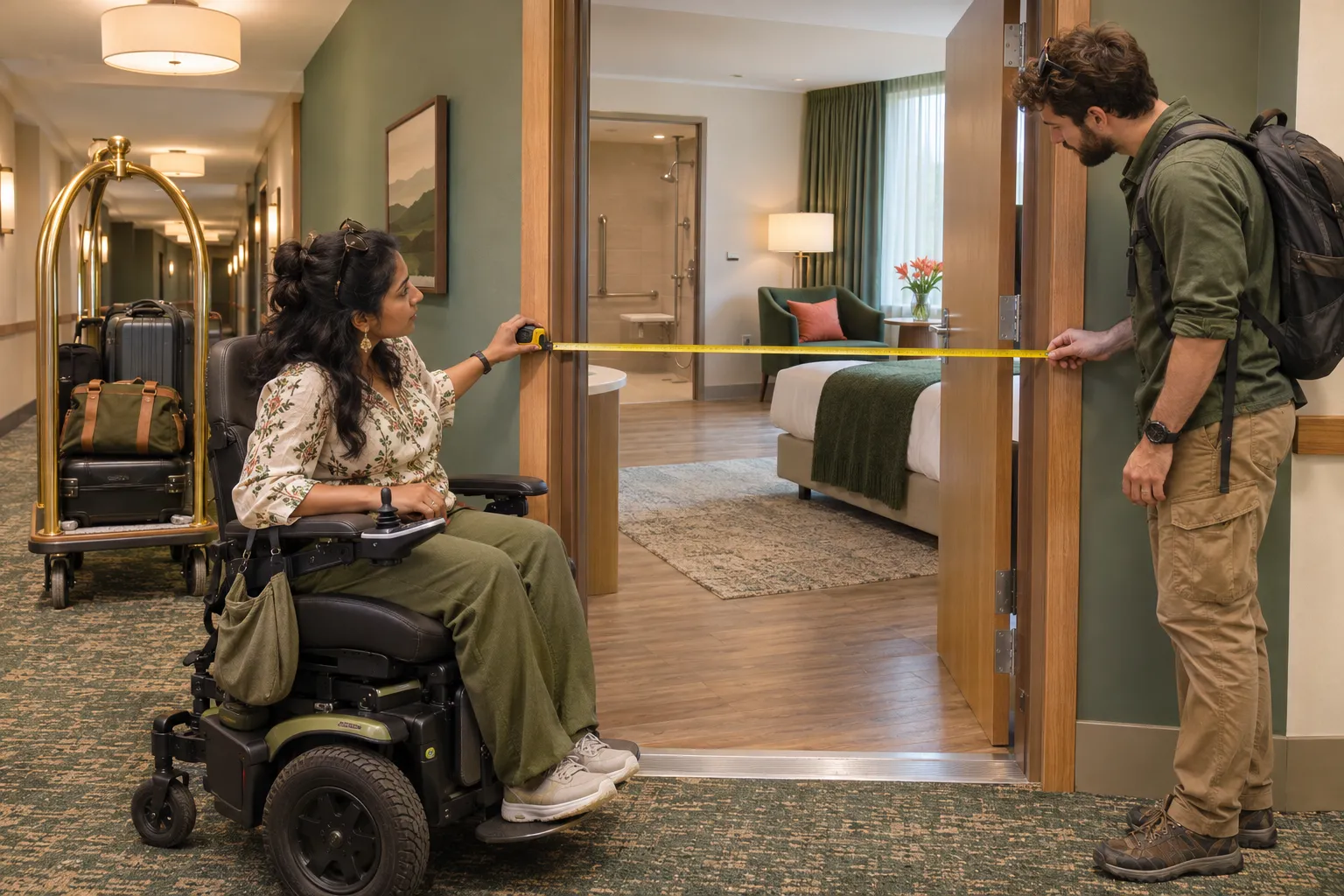
Access needs become specific requests. The word "accessible" alone may not tell anyone the width of a door, the layout of a bathroom, the height of a bed, or whether the route from parking is step-free. Ask the provider for measurements, routes, equipment, bathroom features, seating, alarms, communication options, and transportation details.
For lodging in the United States, the ADA Title III regulations call for reservation systems at covered hotels to identify and describe accessible features, and the details still vary by property. For flights, the Department of Transportation's travel tips for people with disabilities cover airline assistance, advance notice for some accommodations, and how to reach an airline's Complaint Resolution Official.
Also decide what happens if symptoms, fatigue, pain, or sensory overload change the schedule. A plan that includes a rest afternoon is easier to keep than one that treats rest as a failure.
Plan time together, time apart, and the people who depend on you
Pick one or two things each person most wants to do, mark the rest as optional, and leave open space. A long weekend with six reservations leaves little room to be a person who is tired, hungry, or in need of quiet.
Separate time is part of a good visit. Plan for sleep, exercise, a call with a friend, time with family, work, a hobby, or an hour alone. Agree on a friendly way to ask for a break, such as "I'd like an hour on my own, and then I'd love to join you for dinner," so a pause isn't read as rejection. If you're also working out how to stay in touch between visits, the guide on how often long-distance couples talk covers rhythm and expectations.
Work and caregiving belong in the plan too. Name the duties that must stay covered: elder care, child care, pet care, medical, religious, or community commitments. Decide who handles them while one person travels, consider time zones and shift schedules, and plan for the chance that approved leave is denied. A backup date costs nothing to write down.
Write a change and cancellation plan
Plans change because of flights, jobs, illness, and caregiving. A written change plan means nobody has to negotiate under stress. Put the cancellation deadlines, contacts, backup lodging, reserve money, and a way home in the outline before you book. Decide who contacts the airline, the lodging provider, an employer, or a caregiver, and which circumstances allow either person to postpone, shorten, or leave without a penalty in the relationship.
U.S. airline rules give some protection. For a ticket bought at least seven days before departure, the airline must either let you cancel within 24 hours for a full refund or hold the fare for 24 hours without payment, and it does not have to offer both, according to the Department of Transportation's ticket-buying guidance. That rule does not apply in the same way to tickets bought through online travel agencies or other agents.
If an airline cancels or significantly changes a flight to, from, or within the United States, and you decline the replacement flight, credit, voucher, or miles, you are generally entitled to a refund under the Department of Transportation's refund guidance.
A significant change includes a domestic departure at least three hours earlier or an arrival at least three hours later, an international departure or arrival changed by six hours, a different origin or destination airport, an added connection, or a downgrade. Eligible refunds generally must be paid within seven business days for credit-card purchases and 20 calendar days for other payment methods. A credit or voucher offered instead of a refund generally must stay valid for at least five years.
If a paid service is never delivered, you can ask the seller for a refund first. A credit-card customer may also be able to dispute the charge, and the Consumer Financial Protection Bureau says billing-error notices generally must be sent within 60 days after the charge appears on the statement. USAGov's travel complaint page explains where to turn if the provider doesn't resolve the problem. Rules vary by purchase, provider, and state.
Add international checks when the visit crosses a border
Entry rules depend on citizenship, passport, destination, transit points, purpose and length of stay, age, dual nationality, and local law. Before booking, check the U.S. Department of State's guidance for Americans traveling abroad and the country's travel advisory, then confirm final requirements with the destination's embassy or immigration authority and every transit country. Travelers who aren't U.S. citizens should consult their own government as well.
Confirm passport validity and blank-page requirements, visa or electronic travel authorization rules, health documents, medication rules, insurance, and local laws. An approved visa or travel authorization does not guarantee admission at the border. For visitors coming to the United States under the Visa Waiver Program, ESTA is not a visa, and approval does not guarantee entry.
If a minor will travel, check birth-certificate, custody, consent-letter, passport, and exit rules for each country involved, starting with the State Department's travel with minors guidance. If the visit involves an LGBTQ+ traveler, a nonbinary passport marker, a same-sex relationship, a chosen-family member, or different surnames, read the department's guidance for LGBTQ+ travelers and local recognition and documentation rules before you book. Keep copies of documents and an emergency contact with the itinerary.
Plan a safer first meeting
If you met online and haven't been together in person, a few habits keep your options open. Meet when you're ready; pressure to travel quickly, keep the relationship secret, or send money is a reason to slow down. Tell a trusted person who you're meeting, where, when, and how to reach you. Meet first in a busy public place, arrange your own transportation, and keep control of your phone, money, identification, tickets, and lodging. Staying in the other person's home can wait until after the first meeting.
RAINN's safer dating tips add an agreed check-in or code word, enough money and battery to leave, and permission to leave without further explanation.
Never send money, gift cards, cryptocurrency, wire transfers, or payment-app transfers to someone you haven't met. The Federal Trade Commission calls requests like these a scam warning. If money has already gone out, contact the bank or payment company promptly and report it at ReportFraud.ftc.gov.
When joint planning is not a good fit
A shared outline works when both people can say no, suggest changes, keep some things private, and decline the visit without retaliation. If one person is afraid to say no, is being monitored, or has money, documents, or travel controlled by the other person, joint planning is optional, and nothing requires it.
Fear of retaliation, threats, stalking, repeated unwanted contact, monitoring of phones, accounts, or location, control of money or documents, pressure to travel or to give up an independent way home, and sexual pressure are all reasons to pause.
You don't need a label for the relationship first. A safer option may be to plan privately, postpone travel, keep your own lodging and transportation, or contact an advocate from a device and place the other person can't reach. Technology use can be monitored, and changing settings can sometimes raise risk, so individual guidance from a specialist is worth having. The Department of Justice's guidance on domestic violence and stalking, and The Hotline's page on technology-facilitated abuse, explain these patterns.
In the United States, call 911 for immediate danger. The National Domestic Violence Hotline is at 800-799-SAFE (7233), TTY 800-787-3224, or online chat through The Hotline. The RAINN National Sexual Assault Hotline is 800-656-HOPE (4673), with online chat or a text of HOPE to 64673 through RAINN. VictimConnect, listed by the Department of Justice, is at 855-4-VICTIM (855-484-2846) for stalking and crime-victim support.
After the visit
Within a few days, talk about what worked, what cost more than expected, what felt sustainable, and what to change next time. Review cost, energy, access, enjoyment, privacy, and how the time together and apart felt. A review is an invitation to adjust. It does not obligate anyone to repeat the same plan or to continue the relationship.
If your conversations turn toward moving, location, or a timeline, those decisions deserve their own space; see talking about the future for questions that go beyond a single visit.
Questions people ask
How do we plan a long-distance visit together?
Write one outline covering dates, full cost, travel, lodging, access needs, work and caregiving limits, time together and apart, and a backup plan. Agree on a spending limit and who pays each category before anyone books.
Is splitting everything 50/50 always fair?
No. Equal dollars may not reflect different incomes, travel distances, caregiving, work limits, or accessibility costs. Couples can choose individual, shared, proportional, category-based, or rotating arrangements, as long as both people can say yes freely.
Can I cancel an airline ticket within 24 hours?
For a U.S. ticket bought at least seven days before departure, the airline must either allow cancellation within 24 hours for a full refund or hold the fare for 24 hours without payment. It does not have to offer both, and the rule applies differently to tickets from online travel agencies.
What should we include in a visit budget?
Include transportation, baggage, local travel, lodging, food, activities, documents, access needs, insurance, and an emergency reserve. Mark each item as shared, individual, or optional, and decide who pays at booking and when reimbursements happen.
What if planning together does not feel safe?
Joint planning is optional. You can plan privately, keep your own transportation and lodging, and contact a U.S. support route such as the National Domestic Violence Hotline at 800-799-SAFE (7233) from a device and place the other person cannot access.